





The Song of Ceylon + Les statues meurent aussi
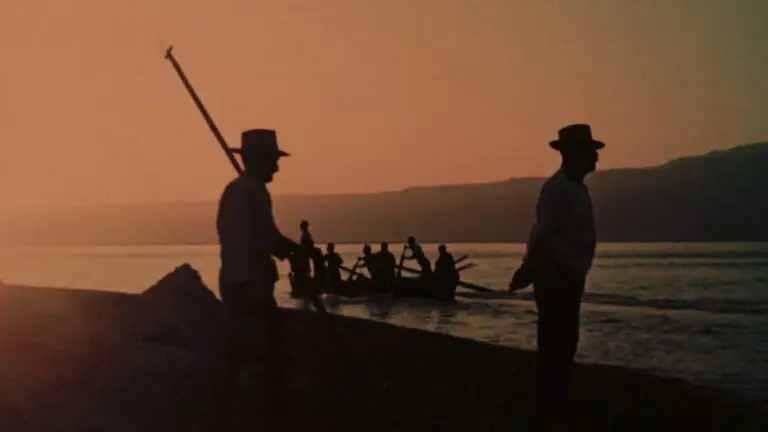
The legendary British documentary THE SONG OF CEYLON (1934, Basil Wright) chronicles the traditional and religious life of what was then Ceylon (now Sri Lanka) across four fluid chapters. Director Basil Wright takes the viewer on a journey from the spiritual Buddhist rituals around Adam’s Peak and artisanal village life to the abrupt arrival of modern industry, before closing with the hypnotic rhythms of a traditional Kandyan dance.
Although the film was originally commissioned as a series of commercial travelogues to promote tea, Wright was given complete carte blanche. Instead of a predictable promotional film, he delivered an independent avant-garde masterpiece. Since no sound equipment was available on location, the soundtrack was constructed afterward in a London studio. Inspired by Soviet montage techniques, Wright combined synthetic sounds, atmospheric music, and historical narration into an innovative soundscape that sharply counterpoints the imagery.
While its commercial backers reacted lukewarmly at the time, the film was an instant triumph on the international festival circuit. Song of Ceylon won the grand prize at the Brussels International Film Festival in 1935, and British author Graham Greene praised the work as the textbook example of perfect editing. Within the history of British cinema, this lyrical film is still regarded as one of the most important and innovative works of early documentary filmmaking, uniquely capturing the tension between tradition and modernization.
The groundbreaking film essay STATUES ALSO DIE (LES STATUES MEURENT AUSSI, 1953) by Chris Marker and Alain Resnais opens with a rhythmic, hypnotic flow of traditional African sculptures and masks. The narrator immediately illustrates how these objects lose their living meaning the moment they are ripped from their original context. Locked away in Western museum showcases, they transform into ‘dead statues’, packaged as exotic objects for the European gaze.
Due to this fierce anti-colonial critique, French censors intervened following its premiere at the Cannes Film Festival. Despite winning the Prix Jean Vigo in 1954, the film remained banned for over a decade. The final section was particularly sensitive at the time. Here, the focus shifts to the commercial exploitation of African culture and the position of Black communities in the West. Marker and Resnais show how colonization forced local artists to adapt their expression to Western tastes, starkly contrasting images of rising Black sports and jazz icons with brutal police crackdowns on labor protests.
The result is a fiery plea to view African and European art history as a single, inseparable, universal culture. More than seventy years later, Statues Also Die stands tall as a visionary masterpiece that forces us to critically reflect on our own gaze and historical complicity.
Showtimes


The screening will be preceded by a lecture on documentary film, propaganda, observation and provocative cinema in the 1930s to 1960s at 17:00 by Bjorn Gabriels.