





Barbara Stanwyck
Not everyone has the talent to portray the most detestable woman in film noir history as well as the most gregarious fire cracking screwball dame of that same comedy genre.
Barbara Stanwyck’s talent was a gift she perfected throughout her decade-spanning career. Her story is no Hollywood fairytale, but a testimony of hard work and vision. Stanwyck started out in life as Ruby Stevens, born in Brooklyn and orphaned at four years old when her mother dies and her father abandons her. Moving from the foster home to foster home, she eventually ends up as a nightclub dancer in illegal bars at fifteen. When she turns eighteen, she leaves nightlife behind and pursues her acting dream. Ruby Stevens is no more, Barbara Stanwyck has entered the building. She starts her career on Broadway and quickly travels to Hollywood, where she convince one Frank Capra to cast her in LADIES OF LEISURE (1930). That performance launched one of the most long-lasting careers in showbusiness.
Stanwyck’s life story makes us believe in the impossible, because she achieved the impossible. Director Jacques Tourneur once said about the actress: “She only lives for two things, and both of them are work.” That work ethic paid off and at thirty-seven the poor orphan girl became the best paid woman in the United States.
“I’m a tough old broad from Brooklyn”, that’s how Stanwyck described herself. No bullshit, just Barbara and her movies. That no-nonsense attitude was strengthened by her unique raspy voice, her atypical looks and her versatility. Because of the resilience she built up during her childhood, Barbara unwaveringly weathered any storm on her path. From Pre-code darling to film noir femme fatale, from screwball dame to hardened western queen. Nobody could tell setbacks to F off the way Stanwyck could. Her characters were real women, with as many virtues as flaws. And especially: they were never clichés. Stanwyck effortlessly combined vulnerability with toughness, intelligence with humour, nonchalance with intensity and sex-appeal with gumption. It wasn’t her beauty, but her brilliant mind that fascinated the audience.
There are numerous reasons to love “stand-up dame” Stanwyck. Her passion for her craft, professionalism and her lack of ego for example. She came to set early, befriended the crew, knew her lines and her characters through and through. She jovially shared the screen with other stars, among whom Marilyn Monroe in CLASH BY NIGHT. Monroe shared that Stanwyck was the only Golden Hollywood star who treated her with respect and compassion. Because of Stanwyck’s lack of ego she later made the switch to television, a smart and successful career choice, at a moment when other Hollywood stars looked down on the new format. Her fruitful career covered theatre, film, radio and television: “I intend to go on acting until I’m ninety and they have to shoot me.”
Stanwyck walked the talk: she stood up for civil rights and the abolition of racial segregation in the US. During a shoot in 1950 for example, Stanwyck wanted to check in to her designated hotel with her friend and studio assistant Harriet Coray, when the latter was stopped and referred to a ‘coloured’ hotel. Stanwyck walked out in dismay to check in to the other hotel with Coray, but before she could do so the discrimination policy of the ‘white’ hotel was revoked. A small wave in a much bigger fight, but an important moment in the life of Coray and a testimony to Stanwyck’s integrity.
Another reason to love Stanwyck is that she did as much of her own stunt work as was allowed. From cartwheels and the splits in tight dresses to being dragged by horses on western sets, Stany did it all. So it shouldn’t come as a surprise that many of her co-stars and crew members were immediately charmed by Stanwyck. Actor Henry Fonda, for instance: “Everyone who is close to me knows I’ve been in love with Barbara since I met her. We’ve never had an affair. She’s never encouraged me, but dammit my wife will verify it, my children will confirm it, and now you can testify tot he truth. I don’t know a person who has been so loved by everyone as Stanwyck.”
Our programme BARBARA STANWYCK: A STAND-UP DAME selects some titles from her diverse oeuvre. Stanwyck had the discipline to work in any genre and to excel in any genre: from drama and film noir to screwball comedies and westerns. Stanwyck embodies all of her characters with the same authenticity and empathy. “It takes a Stanwyck to make you care about the girl”, said director Frank Capra about his muse. It’s Stanwyck who convinces the audience that even the most unlikable characters are more than they seem.
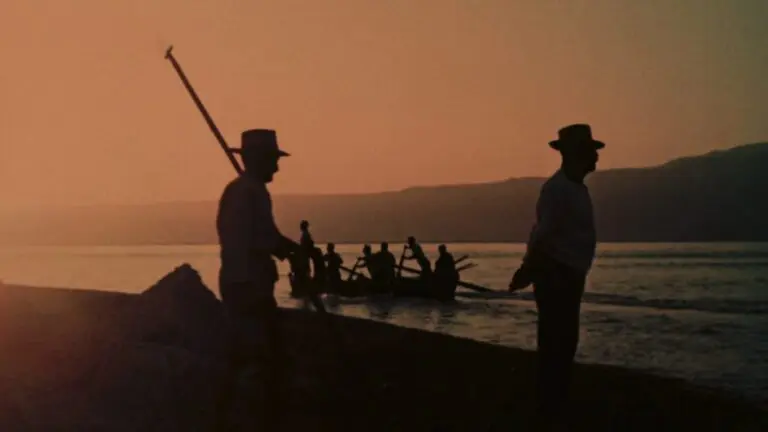
In the aforementioned CLASH BY NIGHT (Fritz Lang, 1952) Stanwyck plays a cynical woman who returns to her hometown after an affair and tries to turn her life around. She marries the naïve fisherman Jerry, but quickly feels restless in her domestic life.
The title of the most hard-boiled femme fatale in film noir history is unanimously assigned to Barbara Stanwyck’s iconic Phyllis Dietrichson from DOUBLE INDEMNITY (Billy Wilder, 1944). Phyllis is unhappy with her marriage and seduces insurance broker Walter Neff (Fred MacMurray) in a plot to end her unhappiness.
Stanwyck was also the uncrowned queen of screwball comedy. Her screwy dames are tough broads with a heart of gold, who give their unsuspecting victims the time of their lives. Gary Cooper’s professor Bertram Potts in BALL OF FIRE (Howard Hawks, 1941) is one of them. The poor man doesn’t stand a chance when mafia mole Sugarpuss O’Shea walks into his office. “Foo, professor. Let’s get ourselves a couple drinks, light the fire maybe, and you can start working on me right away.” The inexperienced professor wants to study Sugarpuss’ vocabulary for a dialect encyclopaedia, but gets much more than he bargained for. He even starts to yodel… Henry Fonda’s Charles Pike faces a similar fate in THE LADY EVE (Preston Sturges, 1941). He isn’t bamboozled just once, but twice by Stanwyck’s Jean Harrington, a conwoman who deceives the gullible heir. “See anything you like?”, she innocently asks her prey.
In STELLA DALLAS (King Vidor, 1937) Stanwyck delivers one of her most heart-wrenching portrayals as a mother who gives up her own happiness for her daughter. The film is also classified as Stanwyck’s favourite.
Stanwyck created another dramatic performance in TITANIC (Jean Negulesco, 1953), where she plays an unhappily married woman aboard the doomed ship. The production of the movie had a profound impact on the actress. “I thought of the men and women who had been through this thing in our time. We were re-creating an actual tragedy and I burst into tears. I shook with great racking sobs and couldn’t stop.” As director Frank Capra learned during his years of working with the actress: “Stanwyck doesn’t act a scene, she lives it.”
As a lover of horses the actress most liked working on westerns. On those sets she could do the greatest stunts, ride horses and spend her time in nature, her most beloved pastime. In THE FURIES (Anthony Mann, 1950) Stanwyck portrays a rejected daughter, who is out for revenge on her rich, soulless father.
In FORTY GUNS (Samuel Fuller, 1958) Stanwyck showed for once and for all why women deserve a seat at the driving wheel of a western, and not just a role as a side character. Stanwyck depicts the notorious Jessica Drummons, the landowners who rules her land, her gang and the nearby town of Tombstone with an iron fist. Director Fuller was known for writing parts of strong women, “protagonists second to no man” in his own words. From the opening credits in FORTY GUNS there is no room for doubt: Jessica – embodied by the fearless Stanwyck, who did her own stunts – is the boss.
Stanwyck didn’t want any bells and whistles, no Hollywood pomp or accolades. There was not a shred of diva in her body. With her signature no-nonsense style and in her own words: “What the hell, whatever I had… it worked, didn’t it?”


