




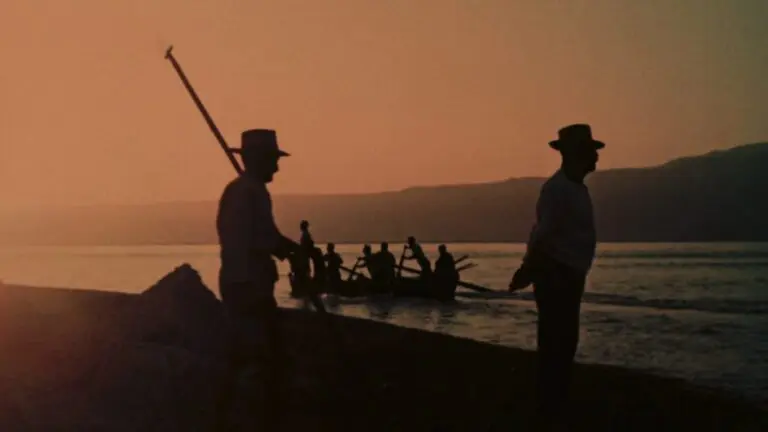


SO CAN I + ONE HUNDRED CHILDREN WAITING FOR A TRAIN
SO CAN I (Abbas Kiarostami, 1975, Iran, 5 min.)
Abbas Kiarostami developed his cinematic language in the classroom. Not at film school, but by using school premises as the setting for his early films. After a brief period during which he combined his studies in fine art with a job as a traffic warden, the Iranian master of cinema made his debut by directing television commercials. In 1969, he was invited to set up the film department at Kanoon (now the Centre for the Intellectual Development of Children and Adolescents). Many of the films from that period are set largely in schools and classrooms.
The short film SO CAN I, which combines live action and animation, illustrates how children learn through imitation, competition and imagination, until the moment when reality can no longer be replicated.
ONE HUNDRED CHILDREN WAITING FOR A TRAIN (Igancio Agüero, 1988, CL, 57′)
ONE HUNDRED CHILDREN WAITING FOR A TRAIN is set in Chile at the end of the 20th century, where censorship and inequality shaped everyday life. Under the guidance of teacher and film historian Alicia Vega, children from deprived neighbourhoods are given the opportunity to create their own films during a workshop. Many of them have never been to a cinema and are now discovering the language and culture of cinema for the first time: camera angles and movements, film genres, Chaplin, Disney, Albert Lamorisse’s The Red Balloon, and the Lumière brothers’ train.
Agüero’s remarkable documentary begins as a tender portrait of the workshop and gradually evolves into a scathing critique of the Pinochet regime by shifting the focus to Vega’s young students and their families, whose cramped homes Agüero visits.
The censors struggled to explain why they had restricted this particular film to viewers over the age of 21. For in doing so, they implicitly acknowledged what Agüero’s film and Vega’s workshop were exposing: the deliberate stratification of classes through poverty and the deprivation of education, cruelly imposed by the dictatorship. But with ONE HUNDRED CHILDREN WAITING FOR A TRAIN, Agüero also, and above all, demonstrates how visual language is a means of imparting knowledge and perspective — both through his own films and the ‘films’ the children make with glue and paper. Perhaps cinema can even lead to freedom?
Showtimes
All screenings have ended


